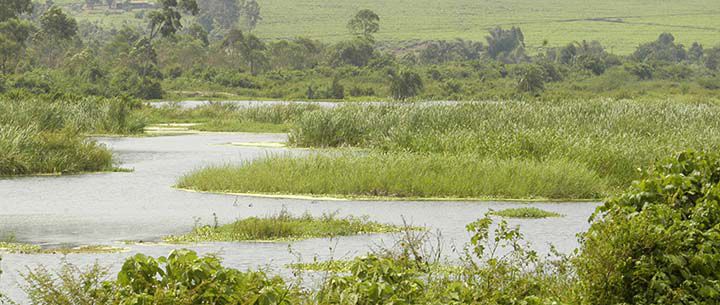
The chirping of weaver birds offers a beautiful tranquil disposition only found in non-degraded ecosystems as one approaches the Komirya wetland system in Bukedea Sub-County, Bukedea district.
The flicking of the green vegetation with gentle winds blowing makes the environment even more relaxing. On the opposite side under a cool tree shade next to the flooded bridge, community members are gathered in ones and twos, as they witness women, young people, and girls from their respective communities, working tirelessly hard to clasp fish for a day’s meal. These among others, are the benefits of the restored Komirya wetland system that Oupei communities are beginning to relish. Previously, this was unheard of, given the rate at which the same communities had converted the wetland into rice fields.
“This wetland you see today was previously rice fields. Communities had created trenches draining water away. The biodiversity, such as birds, had migrated. Fishing opportunities were no more. Nearby springs had all dried up. Women would trek long distances to collect water and grass for thatching their huts. This exposed them to many risks including rape,” David Oluka, the Bukeddea District Natural Resources Officer, explained during a recent visit to Komirya wetland.
Whilst the communities had almost gotten accustomed to the impacts of climate change resulting from their actions, the government through the Ministry of Water and Environment, intervened and restored the wetland using financial support from the Government of Uganda (GoU), the Green Climate Fund (GCF), and the United Nations Development Programme (UNDP).
In 2023, the ministry, working with the district, mobilised communities to collectively respond to the climatic challenges hitting the vulnerable communities. Communities and local authorities were engaged and sensitised on the need to co-exist with the fragile ecosystem. They were urged to vacate the wetland voluntarily, and in return, they would receive alternative livelihoods of their choice. The response was positive. Communities abandoned rice growing. And in a space of six months, the Komirai wetland has almost fully regenerated. The Komirya wetland covers four sub-counties: Bukeddea, Kabarwa, Bukeddea Town Council, and Kolir.
The wetland feeds into Lake Bisiina, one of the Ramsar Sites. With the help of all stakeholders, and more so, community members, the district was able to restore 120ha. Representing approximately 15 km. At the district level, wetland degradation, according to Mr. Oluka, stood at 70%. Nearly every wetland in Bukeddea had been converted to rice fields. Using its meagre resources, the district was only able to restore 60ha. Now, with the project restoring 120ha, the area of restored wetlands in the district stands at least 180ha, representing a positive upward movement in enhancing the district’s conservation efforts. At a recent monitoring visit, the green vegetation had regenerated, biodiversity was returning, the water level had increased, individual household fishing had returned, animals had pasture and water, and communities were harvesting grass for thatching their huts. In addition, communities have enough and clean water for drinking since the neighbouring springs and boreholes that had previously dried have been rejuvenated. Previously, women could suffer searching for water and food to feed their children.
Now, they boast of access to fish, giving them nutrients they previously had forgotten about. Grass for thatching for most communities was very expensive. One bundle of grass would cost as much as shs 20,000, in addition to ferrying it a hundred miles away. One can only imagine the life of a community member without the capacity to afford the grass for thatching lived. With the restoration of Komiryai, such is now history. The communities, including those from afar, are enjoying the free harvest. This level of achievement is a result of collective responsibility, further confirming that wetland restoration is a function of effective stakeholder engagement. Once this happens, sustainability issues automatically fall into place, as Oluka explains:
“Before we restored the wetland, we had to engage all concerned people. We worked with the women, LCs, Youth, district leadership, and technical teams to reach this point. However, good community buy-in requires the appropriate level of sensitization. When we were restoring, the communities were the ones blocking the channels they had previously dug.”
There is, however, fear that as communities continue enjoying the benefits of the restored wetland, they could end up over-harvesting the grass. The need to regulate the practice is thus essential. A wetland management plan and functional user resource committee could be the ideal solution.