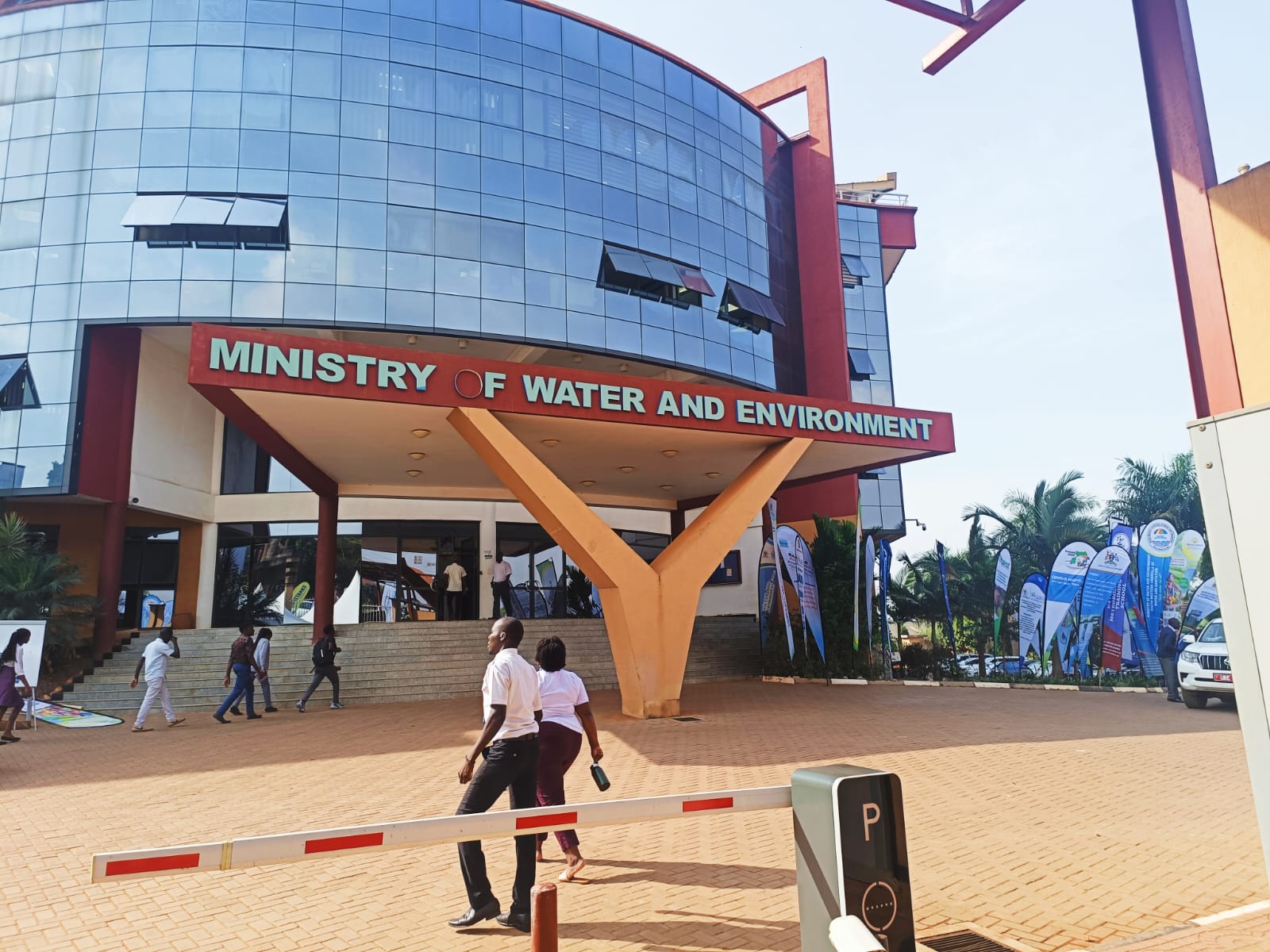
MWE Headquarters

Publications & Documents

289 publications found
ESMF AF IFPA-CD May 9 2025
Reports • Project

ESMF AF IFPA-CD May 9 2025

An Environmental and Social Management Framework (ESMF) outlines mechanisms for the screening of proposed project activities and identified potential environmental and social impacts and their subsequent management.

• 1.90 MB
Download • 274 downloads
STAKEHOLDER ENGAGEMENT PLAN (SEP) MWACRID

MULTI-PURPOSE WATER FOR CLIMATE RESILIENCE AND IRRIGATION DEVELOPMENT FOR LIVELIHOOD TRANSFORMATION (MWACRID) PROJECT IN THE SUB-COUNTIES OF MASINDI-PORT AND KIGUMBA IN KIRYANDONGO DISTRICT; MIRYA AND KIMENGO IN MASINDI DISTRICT, UGANDA, STAKEHOLDER ENGAGEMENT PLAN

• 6.66 MB
Download • 371 downloads

As per the World Bank ESF, concretely ESS5, the Government of Uganda is required to develop a Process Framework (PF) for this Project. A process framework is prepared when Bank-supported projects may cause restrictions in access to natural resources in legally designated protected areas. The purpose of the PF is to establish a process by which members of potentially affected communities participate in design of project components, determination of measures necessary to achieve the objectives of ESS5 and implementation and monitoring of relevant project activities

• 0.88 MB
Download • 388 downloads

The Mid Term Review (MTR) evaluation was conducted to assess the progress made by the project towards achieving its objectives, identify challenges and opportunities, and make practical recommendations for the project to effectively deliver on its objectives and targets, including any adjustments in scope and implementation as may be deemed necessary. This report summarises the MTR’s main findings, conclusions and recommendations

• 8.21 MB
Download • 609 downloads

The Labour Management Plan (LMP) was designed to guide project engagements with external stakeholders most especially employees and guides on how to engage with different types of workers such as direct workers include the PCU staff which are hired under contract to the project for the duration of the project implementation, contracted workers including firms, non-governmental organizations (NGOs) or community based organizations (CBOs) that will be contracted as Technical Service Providers (TSP) (total of 4 or more TSP contracts) and who will use existing staff already on the payroll, short-term consultants, community workers who will be employed under the project.

• 0.24 MB
Download • 321 downloads
List of Clean Development Mechanism CDM Projects in Uganda

The Clean Development Mechanism (CDM), defined in Article 12 of the Protocol, allows a country with an emission-reduction or emission-limitation commitment under the Kyoto Protocol (Annex B Party) to implement an emission-reduction project in developing countries. Such projects can earn saleable certified emission reduction (CER) credits, each equivalent to one tonne of CO2, which can be counted towards meeting Kyoto targets.

• 0.09 MB
Download • 358 downloads

The Simu- Muyembe community-based management plan (CBWMP) is developed under the “Strengthening Adaptive Capacity and Resilience of Communities in Uganda’s Watersheds – Awoja Catchment (SACRiAC) – Project” with funding from the Global Environment Facility (GEF) and the African Development Bank. It is presumed that the ten-year plan will ensure the sustainable use and conservation of Simu-Muyende wetland so that it can provide benefits to the community.

• 1.72 MB
Download • 367 downloads
Komirya Community Based Wetland Management Plan 2025-2035

The communities around Komirya wetland, civil society organizations, traditional and political leadership of the six sub counties of Kongunga, Aligoi, Kocheka, Kolir, Aminit, and Kachumbala and Bukedea District Local Government provided invaluable information about wetlands management issues and contributed greatly to designing appropriate management and conservation strategies contained in this plan.

• 1.72 MB
Download • 326 downloads
Reports • Project

About FIEFOC III

The Government of Uganda through the Ministry of Water and Environment (MWE) is implementing the development of three- medium sized irrigation schemes in northern and eastern regions of Uganda, covering an irrigable area of 1,800

• 0.67 MB
Download • 298 downloads
Economic Study for Water and Environment Sector-Uganda Factsheet A3

This analysis models the GDP effects of MWE investment across ten channels of economic impact. First, biophysical and reduced form models are employed to understand the impacts of management decisions. The results of these models are then input to an economy-wide model to estimate the overall economic impacts of MWE investment.

• 1.80 MB
Download • 378 downloads
Irrigation Development in Uganda_Constraints, Lessons Learned, and Future Perspectives

Policy makers in sub-Saharan African (SSA) countries have identified irrigation as a key ingredient to boosting food security and income as well as a precursor for agricultural development. However, most SSA countries have hardly exploited their irrigation potential. The overarching aim of this paper is to critically examine factors constraining exploitation of irrigation potential in Uganda. Lessons learned from previous interventions and successes elsewhere from countries comparable to Uganda are drawn and future perspectives to guide effective irrigation planning and development are recommended.

• 0.37 MB
Download • 442 downloads
2015_Mainstreaming Climate Change Into Integrated Water Management Planning for Uganda _Proposed revisions of the Mpanga Catchment Management Plan (D1)

In 2008, the Directorate of Water Resources Management (DWRM) and the Ministry of Water and Environment (MWE) adopted a strategy to de-concentrate IWRM at the regional and river basin or catchment level with central oversight and guidance. One of the mains reasons behind this strategy is that it brings IWRM functions closer to stakeholders (farmers, townspeople, local government officials, etc.). Doing this helps to concentrate the focus onto real problems, to improve the analytical underpinnings of programs and projects and it also provides the opportunity for stakeholders to participate in the formulation of plans and the development of new water infrastructure.

• 0.50 MB
Download • 502 downloads

The GRM is an inclusive and participatory entity that is aimed at facilitating communication between conflicting parties, promoting dialogue, and facilitating a reasonable agreement between the parties to a grievance.

• 0.33 MB
Download • 345 downloads