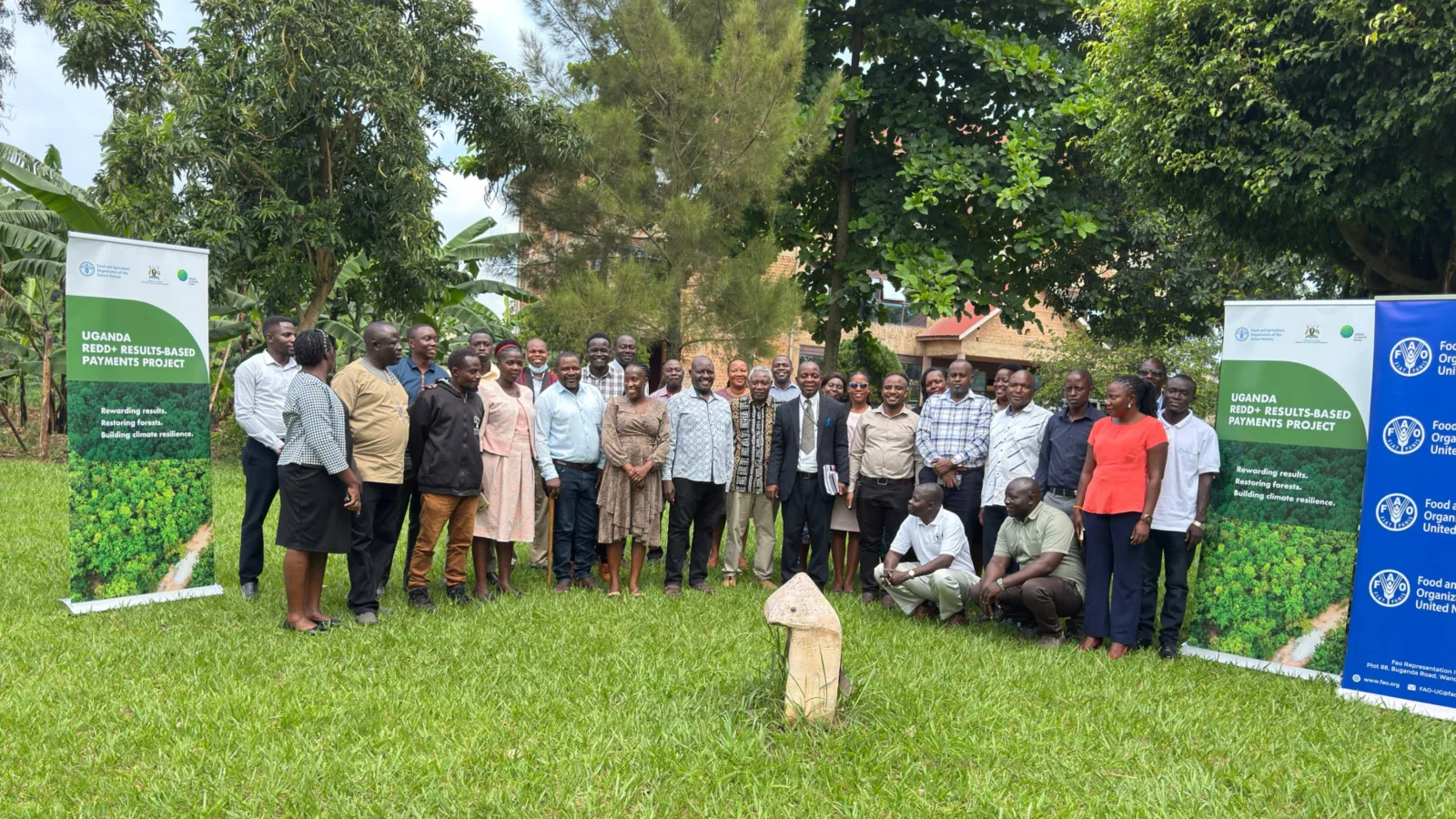
Luwero 4 November 2026, The Ministry of Water and Environment (MWE) together with Food and Agricultural Organization of the United Nations (FAO) are engaging key stakeholders of the Green Climate Fund (GCF), Reducing Emissions from Deforestation and Forest Degradation, plus the conservation, sustainable management of forests, and enhancement of forest carbon stocks in developing countries (REDD+) Results-Based Payment project.
Addressing the workshop participants, the Luwero Resident District Commissioner, Ms. Nalubega Mariam Seguya, welcomed the project, noting that it comes at a critical time when communities are increasingly experiencing the adverse effects of climate change. She reaffirmed Government’s commitment to climate change mitigation and adaptation efforts and pledged to closely monitor the project to ensure its effective implementation and delivery of the intended results.
The two days’ regional stakeholder consultation workshop in Luwero targeted Department of Forestry Management under the Ministry of Water and Environment, the district local governments technical officials from the project targeted districts, representatives of forest based community enterprises and representative of the special interest groups.
The Results-Based Payment project was awarded to Uganda based on the eight million metric tonnes of carbon dioxide equivalent (8M tCO2) verified REDD+ results between 2016-2017. The project is funded by the Green Climate Fund with a total of thirty one million (31,000,000) US dollars and implemented by FAO and the Ministry of Water and Environment within a period of seven (7) years.
The project activities target one hundred and five thousand (105,000) people as indicative beneficiary reach within the seventeen (17) targeted districts that include; Apac, Amolatar, Nakasongola, Luwero, Buyende, Kayunga, Mukono, Wakiso, Kamuli, Luuka, Iganga, Buikwe, Kween, Bukwo, Bulambuli, Sironko and Kapchorwa. In these districts the project is estimated to benefit 21,000 field intervention potential.
The project implementation plan is divided into two components that is;
i. Enabling environment and REDD+ governance. This component is led by the Ministry of Water and Environment and aims at strengthening the institutional architecture required for credible, inclusive and durable REDD+ implementation.
ii. Priority landscape investments. This component is led by FAO, will translate REDD+ proceeds into field-level action through four mutually reinforcing investment streams comprising of sustainable land management and agroforestry of 7,000 ha, sustainable fuelwood and charcoal of 3,000 ha, pole and timber plantations 3,000 ha and natural forest restoration 8,200 ha.
By the end of the project, Uganda is expected to achieve the following outcomes:
a) A functioning Monitoring, Reporting, and Verification (MRV) and National Forest Monitoring System architecture, better activity data and emission factors, stronger safeguards reporting, and improved alignment between REDD+ and NDC processes.
b) More land under sustainable management, agroforestry, plantations and natural forest restoration, with improved ecosystem services and enhanced carbon removals.
c) Improved food security, diversified incomes, green jobs, value addition, market access and more reliable access to sustainable biomass energy.
d) More secure access to land and forest resources, stronger community institutions, equitable benefit sharing and meaningful participation of women, youth, persons with disabilities, Indigenous Peoples and other marginalized groups.
The workshop was opened by the Luwero Deputy Chief Accounting Officer Keith Bahemuka remarked that “we eat, work and live in the environment, therefore must support it in terms of monitoring and supervising to ensure its objective are achieved”.
The Assistant Commissioner Forestry Assessment and Mapping Bob Kazungu represented by Forest Officer Saul Ndyabandiho highlightedthat the successful implementation of the project is expected to strengthen Uganda’s efforts towards climate change mitigation, sustainable forest management and environmental conservation.
He further added that through collaboration between Government, development partners and local communities, the project will contribute to reducing greenhouse gas emissions, enhancing ecosystem resilience and improving community livelihoods. Ultimately, the project will support Uganda’s commitment to addressing climate change while advancing its national and international environmental and climate action targets.