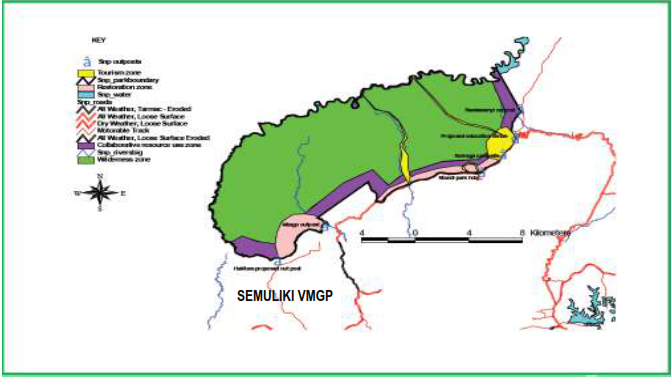
Semuliki Validated VMGP FINAL -IFPA-CD-DEC 2025
Vulnerable and Marginalized Groups Plan for the Batwa around Semuliki National Park
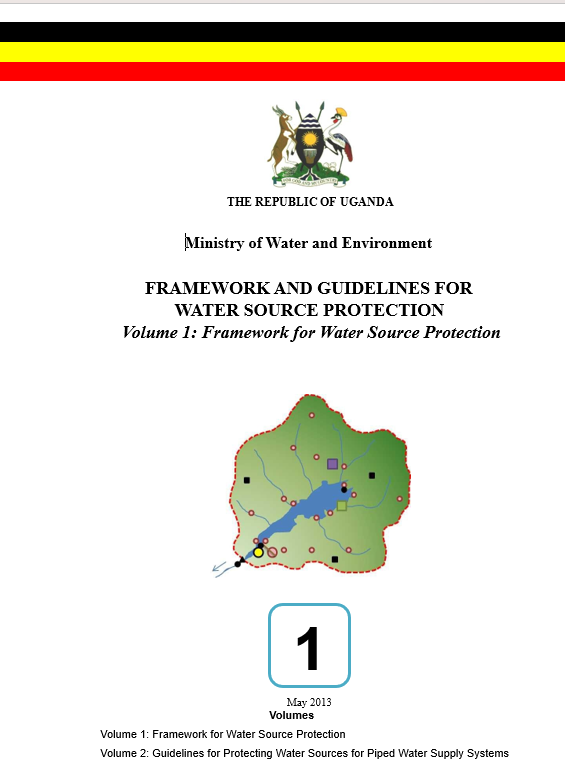
The four volumes (2-5) of specific guidance are intended for water infrastructure managers and relevant government officials at the national and district levels and are intentionally concise to encourage their uptake and use. However, some users may want, or need, a deeper insight into the water source protection process.
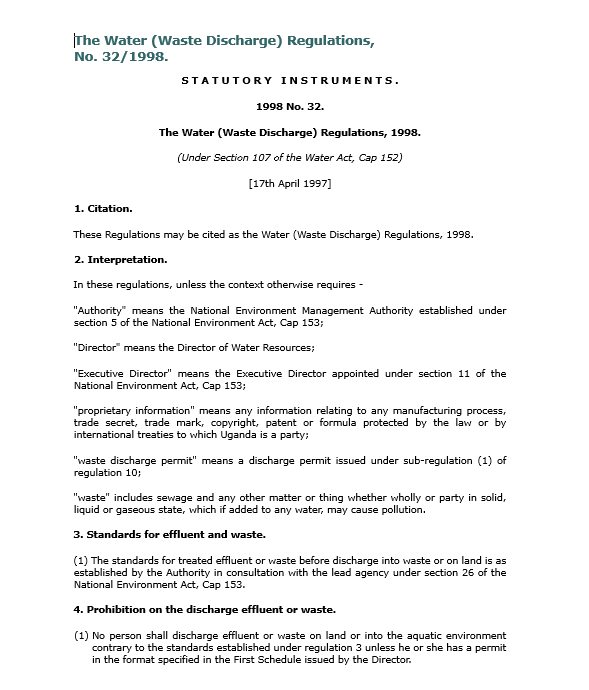
In these regulations, unless the context otherwise requires – “Authority” means the National Environment Management Authority established under section 5 of the National Environment Act, Cap 153; “Director” means the Director of Water Resources; “Executive Director” means the Executive Director appointed under section 11 of the National Environment Act, Cap 153;
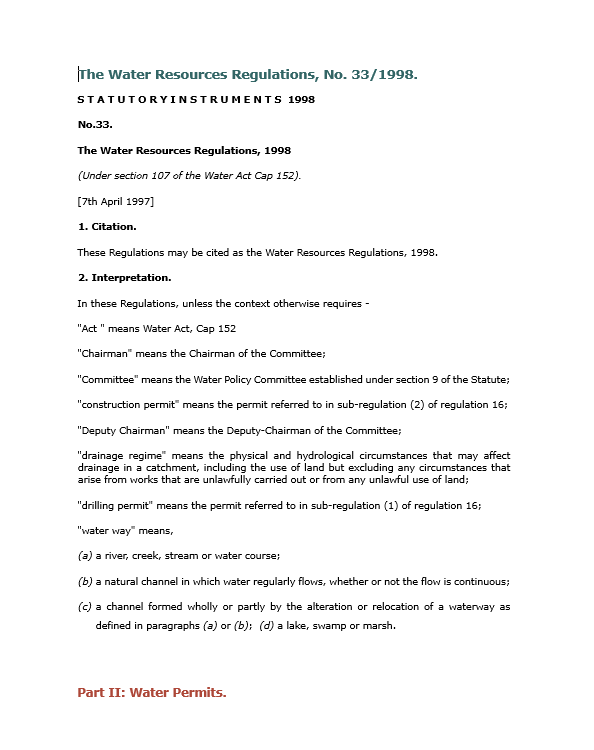
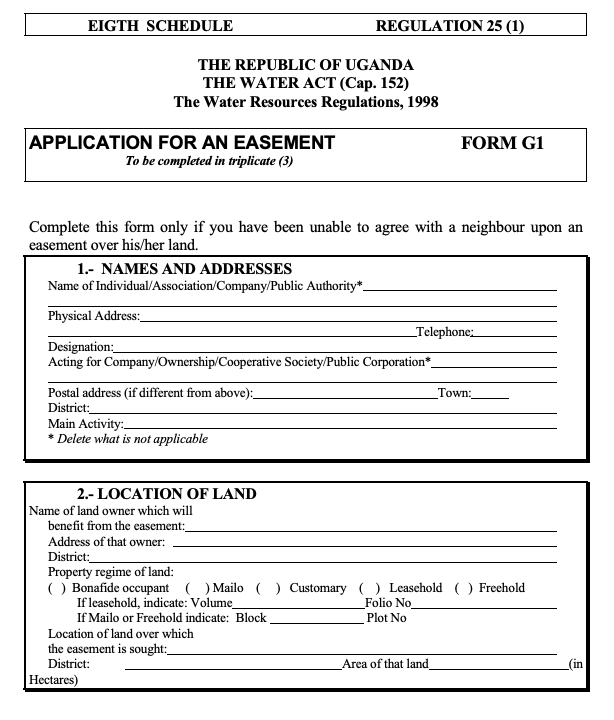
In these Regulations, unless the context otherwise requires – “Act ” means Water Act, Cap 152 “Chairman” means the Chairman of the Committee; “Committee” means the Water Policy Committee established under section 9 of the Statute; “construction permit” means the permit referred to in sub-regulation (2) of regulation 16; “Deputy Chairman” means the Deputy-Chairman of the Committee; “drainage regime” means the physical and hydrological circumstances that may affect drainage in a catchment, including the use of land but excluding any circumstances that arise from works that are unlawfully carried out or from any unlawful use of land; “drilling permit” means the permit referred to in sub-regulation (1) of regulation 16;
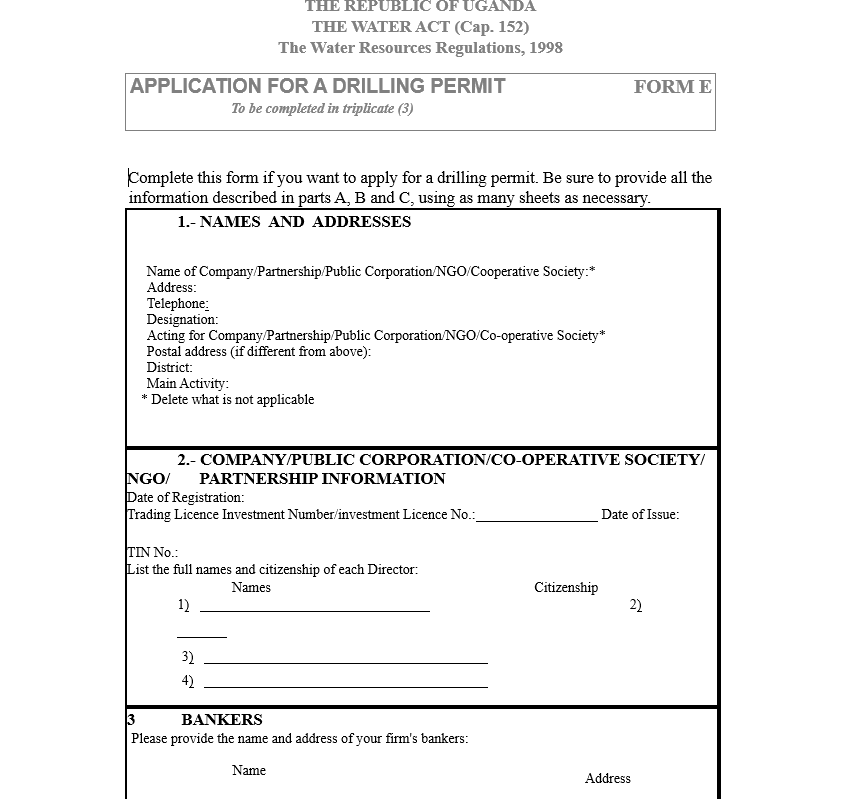
Complete this form if you want to apply for a drilling permit. Be sure to provide all the information described in parts A, B and C, using as many sheets as necessary.
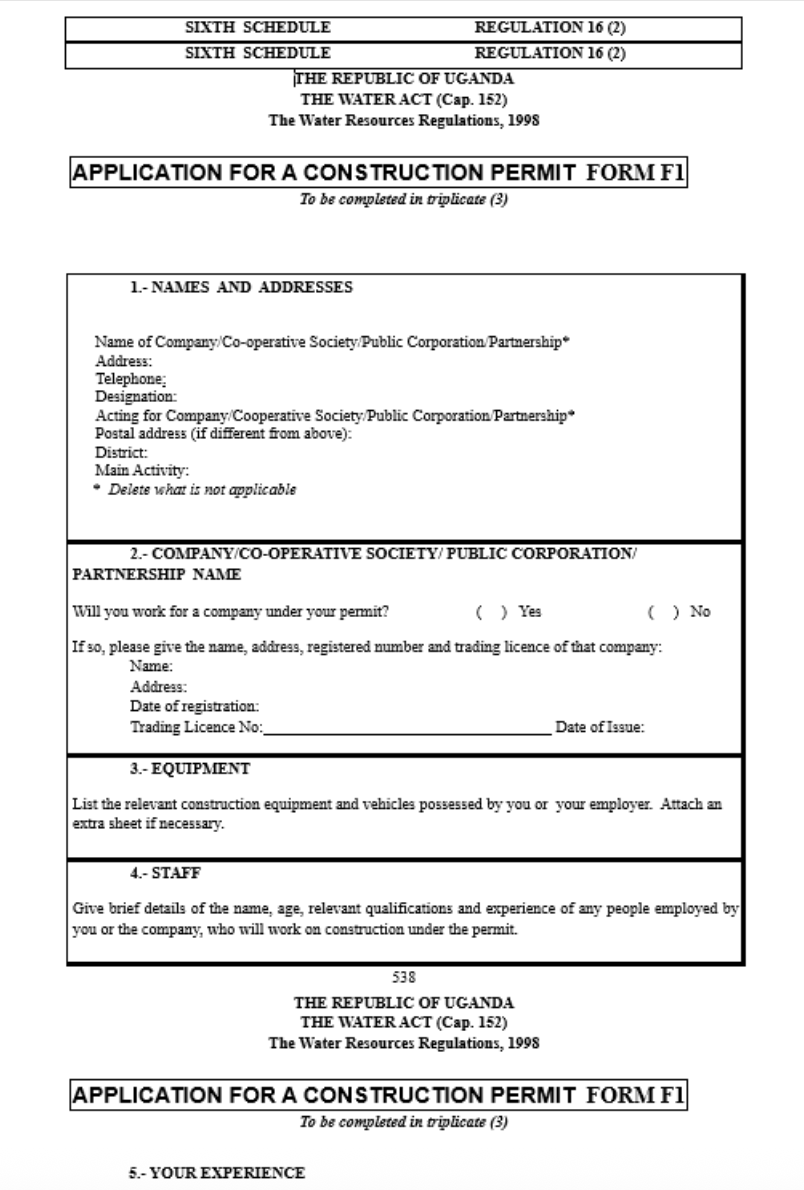
Construction Application Form
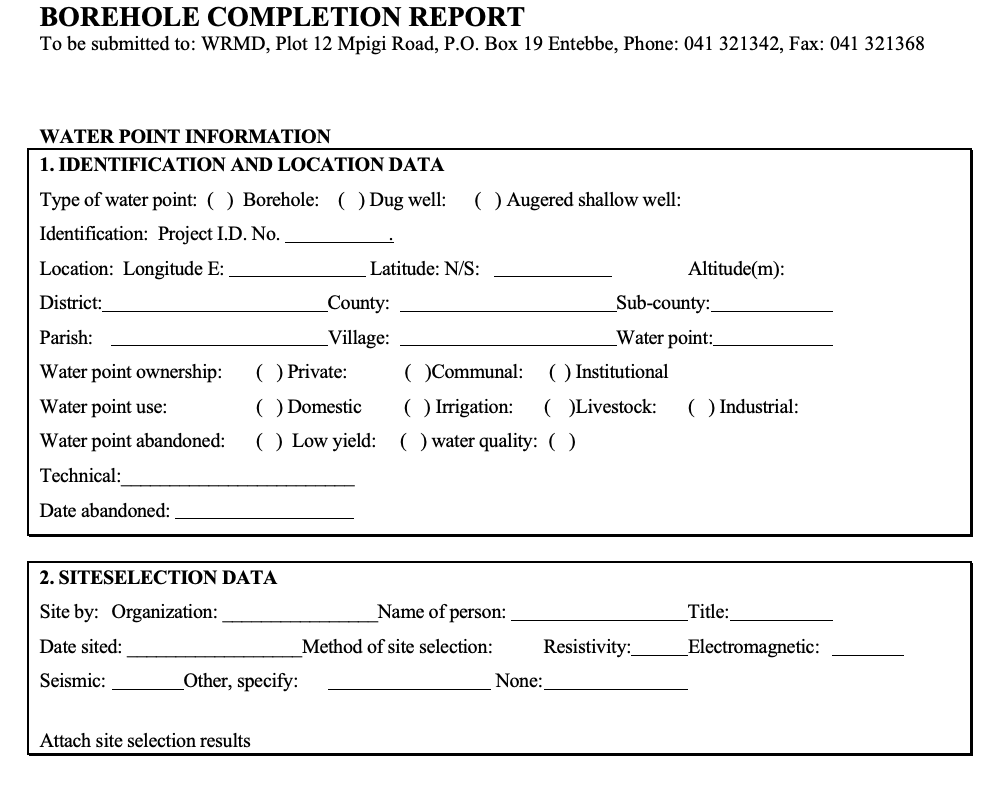
BOREHOLE COMPLETION REPORT To be submitted to: WRMD, Plot 12 Mpigi Road, P.O. Box 19 Entebbe, Phone: 041 321342, Fax: 041 321368
The Gender Action Plan (GAP) was developed at the start of project implementation to guide gender mainstreaming in project activities. It identified gender gaps from each project components, proposed actions to reduce the gaps, indicators and targets.
An Environmental and Social Management Framework (ESMF) outlines mechanisms for the screening of proposed project activities and identified potential environmental and social impacts and their subsequent management.
Draft Environmental and Social Management Framework (ESMF) JAN 2020 IFPA-CD
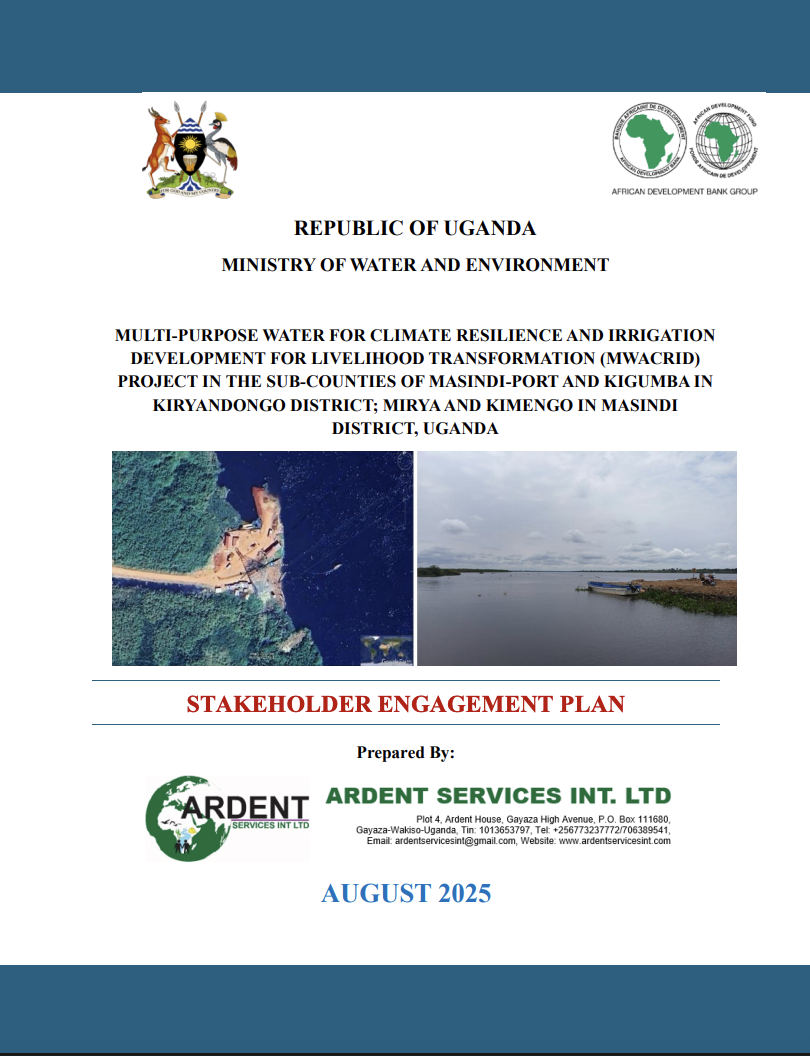
MULTI-PURPOSE WATER FOR CLIMATE RESILIENCE AND IRRIGATION DEVELOPMENT FOR LIVELIHOOD TRANSFORMATION (MWACRID) PROJECT IN THE SUB-COUNTIES OF MASINDI-PORT AND KIGUMBA IN KIRYANDONGO DISTRICT; MIRYA AND KIMENGO IN MASINDI DISTRICT, UGANDA, STAKEHOLDER ENGAGEMENT PLAN
As per the World Bank ESF, concretely ESS5, the Government of Uganda is required to develop a Process Framework (PF) for this Project. A process framework is prepared when Bank-supported projects may cause restrictions in access to natural resources in legally designated protected areas. The purpose of the PF is to establish a process by which members of potentially affected communities participate in design of project components, determination of measures necessary to achieve the objectives of ESS5 and implementation and monitoring of relevant project activities
The Mid Term Review (MTR) evaluation was conducted to assess the progress made by the project towards achieving its objectives, identify challenges and opportunities, and make practical recommendations for the project to effectively deliver on its objectives and targets, including any adjustments in scope and implementation as may be deemed necessary. This report summarises the MTR’s main findings, conclusions and recommendations
The Labour Management Plan (LMP) was designed to guide project engagements with external stakeholders most especially employees and guides on how to engage with different types of workers such as direct workers include the PCU staff which are hired under contract to the project for the duration of the project implementation, contracted workers including firms, non-governmental organizations (NGOs) or community based organizations (CBOs) that will be contracted as Technical Service Providers (TSP) (total of 4 or more TSP contracts) and who will use existing staff already on the payroll, short-term consultants, community workers who will be employed under the project.
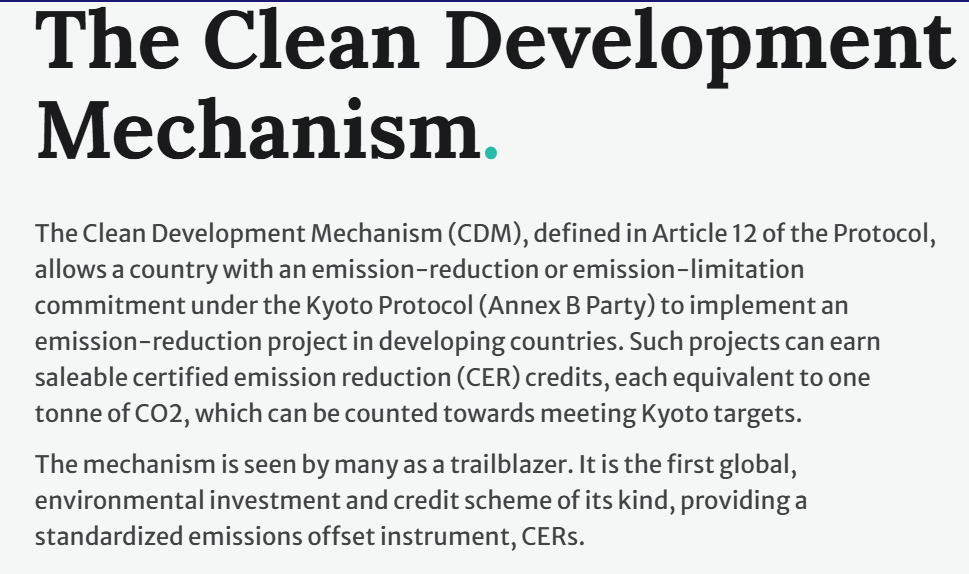
The Clean Development Mechanism (CDM), defined in Article 12 of the Protocol, allows a country with an emission-reduction or emission-limitation commitment under the Kyoto Protocol (Annex B Party) to implement an emission-reduction project in developing countries. Such projects can earn saleable certified emission reduction (CER) credits, each equivalent to one tonne of CO2, which can be counted towards meeting Kyoto targets.
EPRP (MWACRID)- For Disclosure
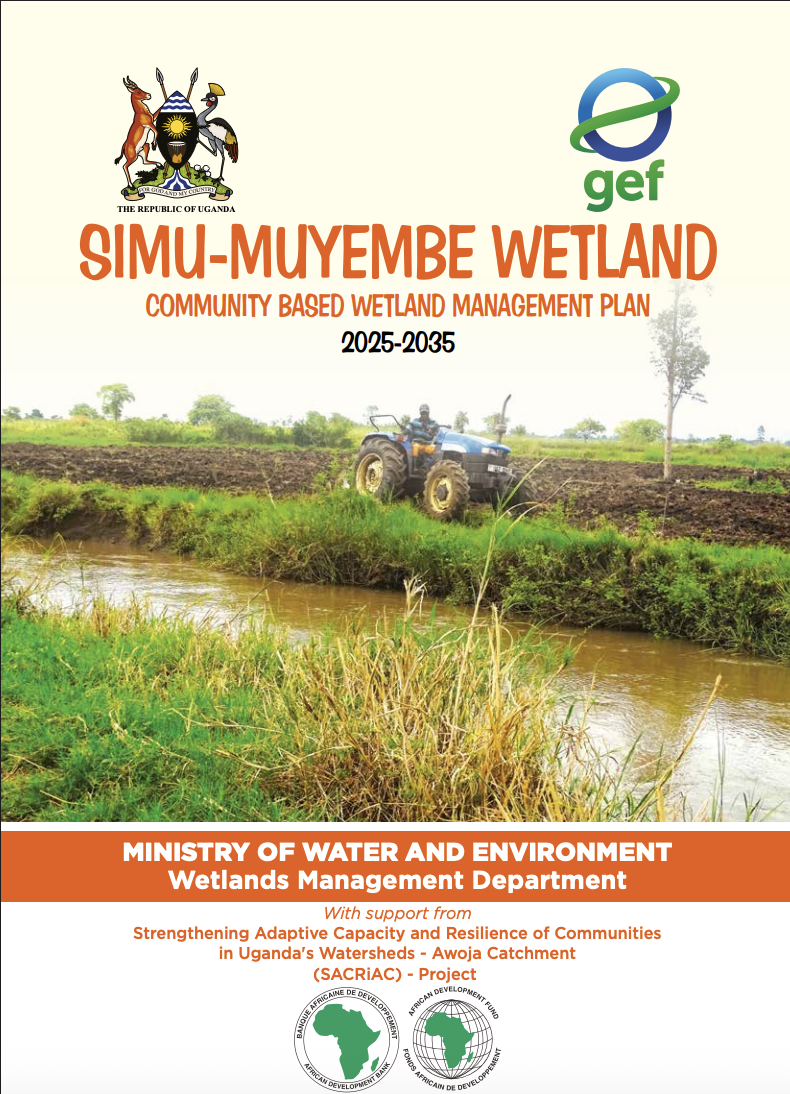
The Simu- Muyembe community-based management plan (CBWMP) is developed under the “Strengthening Adaptive Capacity and Resilience of Communities in Uganda’s Watersheds – Awoja Catchment (SACRiAC) – Project” with funding from the Global Environment Facility (GEF) and the African Development Bank. It is presumed that the ten-year plan will ensure the sustainable use and conservation of Simu-Muyende wetland so that it can provide benefits to the community.
The communities around Komirya wetland, civil society organizations, traditional and political leadership of the six sub counties of Kongunga, Aligoi, Kocheka, Kolir, Aminit, and Kachumbala and Bukedea District Local Government provided invaluable information about wetlands management issues and contributed greatly to designing appropriate management and conservation strategies contained in this plan.
The Government of Uganda through the Ministry of Water and Environment (MWE) is implementing the development of three- medium sized irrigation schemes in northern and eastern regions of Uganda, covering an irrigable area of 1,800