EPRP (MWACRID)- For Disclosure
The Simu- Muyembe community-based management plan (CBWMP) is developed under the “Strengthening Adaptive Capacity and Resilience of Communities in Uganda’s Watersheds – Awoja Catchment (SACRiAC) – Project” with funding from the Global Environment Facility (GEF) and the African Development Bank. It is presumed that the ten-year plan will ensure the sustainable use and conservation of Simu-Muyende wetland so that it can provide benefits to the community.
The communities around Komirya wetland, civil society organizations, traditional and political leadership of the six sub counties of Kongunga, Aligoi, Kocheka, Kolir, Aminit, and Kachumbala and Bukedea District Local Government provided invaluable information about wetlands management issues and contributed greatly to designing appropriate management and conservation strategies contained in this plan.
The Government of Uganda through the Ministry of Water and Environment (MWE) is implementing the development of three- medium sized irrigation schemes in northern and eastern regions of Uganda, covering an irrigable area of 1,800
This analysis models the GDP effects of MWE investment across ten channels of economic impact. First, biophysical and reduced form models are employed to understand the impacts of management decisions. The results of these models are then input to an economy-wide model to estimate the overall economic impacts of MWE investment.
Policy makers in sub-Saharan African (SSA) countries have identified irrigation as a key ingredient to boosting food security and income as well as a precursor for agricultural development. However, most SSA countries have hardly exploited their irrigation potential. The overarching aim of this paper is to critically examine factors constraining exploitation of irrigation potential in Uganda. Lessons learned from previous interventions and successes elsewhere from countries comparable to Uganda are drawn and future perspectives to guide effective irrigation planning and development are recommended.
In 2008, the Directorate of Water Resources Management (DWRM) and the Ministry of Water and Environment (MWE) adopted a strategy to de-concentrate IWRM at the regional and river basin or catchment level with central oversight and guidance. One of the mains reasons behind this strategy is that it brings IWRM functions closer to stakeholders (farmers, townspeople, local government officials, etc.). Doing this helps to concentrate the focus onto real problems, to improve the analytical underpinnings of programs and projects and it also provides the opportunity for stakeholders to participate in the formulation of plans and the development of new water infrastructure.
Summary – Vulnerable and Marginalized Groups Framework (VMGF) for Uganda – English Version (October 2020)
The GRM is an inclusive and participatory entity that is aimed at facilitating communication between conflicting parties, promoting dialogue, and facilitating a reasonable agreement between the parties to a grievance.
VULNERABLE & MARGINALISED GROUPS’ FRAMEWORK (VMGF) FOR MATANDA AND ENENGO IRRIGATION SCHEMES IN KANUNGU AND RUKUNGIRI DISTRICTS
Resettlement Policy Framework-RPF Feb 2019
ENVIRONMENTAL AND SOCIAL COMMITMENT PLAN (ESCP)
RESETTLEMEMENT ACTION PLAN (RAP) FOR KABUYANDA IRRIGATION DEVELOPMENT AND CLIMATE RESILIENCE PROJECT (IDCRP) IN ISINGIRO DISTRICT
The Project Development Objective is to to improve sustainable management of forests and protected areas and increase benefits to communities from forests in target landscapes.
MATANDA DAM SECTIONAL RAP
VULNERABLE AND MARGINALIZED GROUPS FRAMEWORK FOR MATANDA IRRIGATION SCHEME Feb 2025
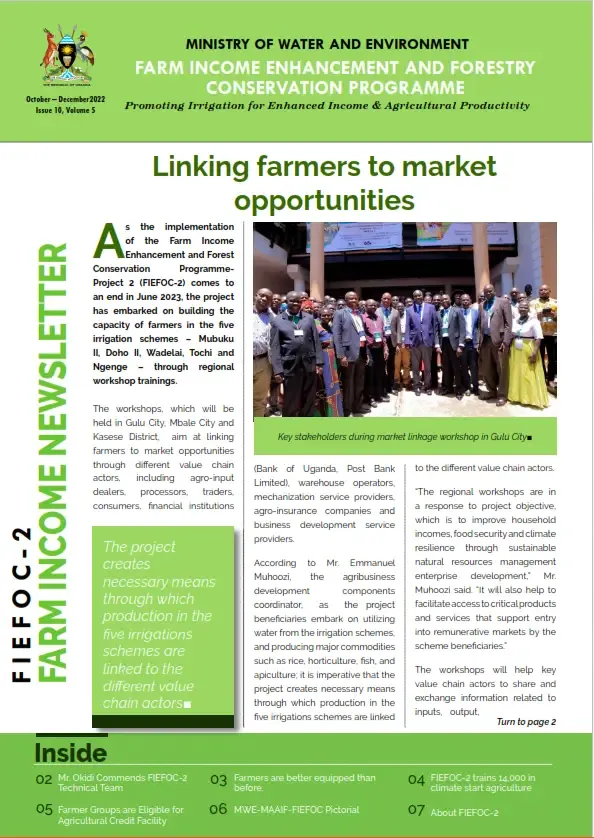
Farm Income Enhancement and Forest Conservation Programme – Project 2 (FIEFOC –2) is designed within the context of the Government of Uganda’s National Development Plan II (NDP II), and the long term development strategy, the Vision 2040 both of which promote agricultural infrastructure and income enhancement.
An Environmental and Social Management Framework (ESMF) outlines mechanisms for the screening of proposed project activities and identified potential environmental and social impacts and their subsequent management.
The Government of Uganda (GoU) is implementing the “Investing in Forests and Protected Areas for Climate-Smart Development (IFPA-CD) Project”. The project is financed by the International Development Association (IDA) of the World Bank and GoU. The implementation of the project is led by the Ministry of Water and Environment (MWE), Uganda Wildlife Authority (UWA), and the National Forestry Authority (NFA).
Natural Resources, Environment, Climate Change, Lands and Water Management Annual Programme Performance Report 2023