
Government, German Partners Inspect Karamoja Water Projects
The Ministry of Water and Environment, alongside international partners and regional leaders, has kicked off a two-day field assessment to inspect water infrastructure aimed at tackling perennial water scarcity in the Karamoja sub-region.
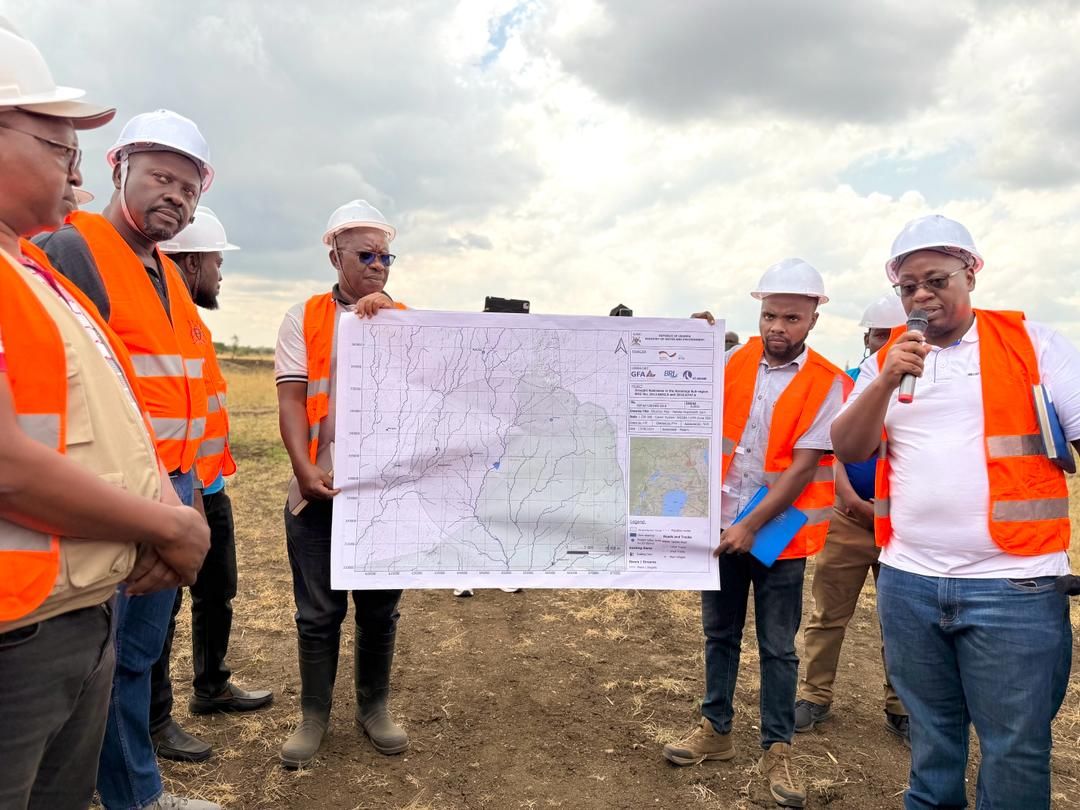
The field inspection at the Naitakiru Valley Tank in Kotido District coincided with the launch of the 4th Project Advisory Committee Meeting for the Karamoja Drought Resilience Project (KDRP).
The delegation, which also paid a courtesy call to Kotido District Local Government, was led by the Assistant Commissioner for Multipurpose Water and Bulk Water Development, Eng. Ronald Kasozi, who represented the Ministry’s Permanent Secretary, Dr. Alfred Okot Okidi.
The high-level monitoring team included Members of Parliament from Amudat, Kotido, Kaabong, and Nakapiripirit districts, local government leaders, representatives from the German Development Bank (KfW), officials from the Water for Production Regional Centre-Karamoja, and the project consultant team - a joint venture of GFA Consulting Group GmbH, BRL Ingénierie, and WE Consult.
On-Site Progress
During the site visit, the committee noted significant progress on the construction of the Naitakiru Valley Tank. Visible works currently underway include the concrete apron, stone masonry installations, and perimeter fencing.
The technical consultant team and the contractor briefed the stakeholders on the design specifications, supervision frameworks, and implementation timelines.
Discussions focused heavily on water storage capacity, catchment area protection, and setting up robust operational management structures to support sustainable livestock production.
Area MPs and district leaders used the opportunity to engage directly with the technical teams, emphasizing the need for community ownership, long-term sustainability, and timely completion to help pastoral communities withstand severe weather shocks.
The Bigger Picture
The Naitakiru facility is one of three critical valley tanks being constructed to support the larger Nangololapolon Dam system. The initiative is co-funded by the Government of Uganda and the Federal Republic of Germany through KfW.
Beyond the valley tanks, the project is also drilling and developing four high-yielding boreholes across Kotido and Kaabong districts.
The intervention seeks to fundamentally strengthen the drought resilience of pastoral and agro-pastoral communities in Karamoja. By improving access to water for both human consumption and livestock, the project aims to curb seasonal distress migration, mitigate resource-based conflicts, and secure local livelihoods