
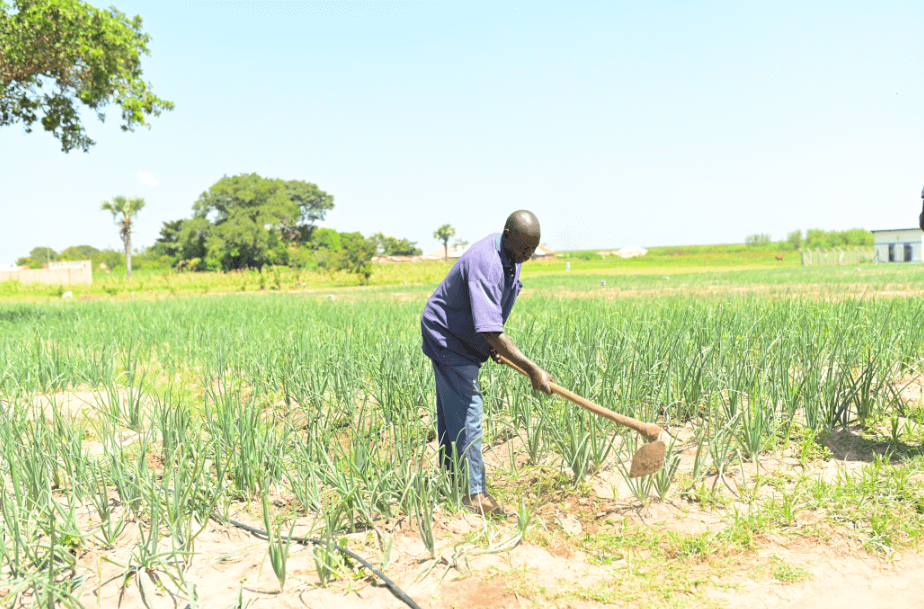
Fishermen Become Farmers as Solar Irrigation Redefines Lugonyola
In Lugonyola village in Kaliro district where the wind once carried the smell of fishing nets dried on verandas, a new rhythm has taken hold, one marked by the steady spray of sprinklers, the rustle of green leaves, and the quiet certainty that tomorrow will be better than yesterday.
Here in Nawampiti parish, Bukamba subcounty in Kaliro district, the Lugonyola Solar-Powered Irrigation Scheme is rewriting a community’s identity and giving fishermen-turned-farmers the tools to cultivate not only food, but hopes.
Powered by an installation built by Nexus Green Ltd under the Ministry of Water and Environment with backing from UK Export Finance, Lugonyola’s scheme draws water straight from Lake Nakuwa, lifting it through solar-driven pumps and releasing it into once-thirsty fields.
Now in its third planting season, the scheme supports 24 farmers, though its reach has quietly extended beyond the village.
Neighbouring communities rent land too, hoping to catch the same wave of progress. What was once a fishing settlement is now an agricultural green belt.
The Story of a Village’s Transformation
For years, Lugonyola’s families survived on cassava, finger millet, and maize crops they could farm only once a year. Rain determined everything, and the lake was their fallback in months of hunger. Many fished not by choice but by necessity. But the irrigation scheme changed their economic map almost overnight.
“We now plant up to four seasons a year,” says Lulayo Mwindi, the LCI chairman, landlord, and one of the people who championed the project. “Where we used to earn around UGX 500,000 from an acre, farmers now get over UGX 2 million. That money changes a home.”
And the impact has spilled into the social fabric.
“Domestic violence has gone down,” Mwindi adds. “When people are busy and earning, they don’t quarrel the way they used to.”
Rogers Musana: A Farmer Who No Longer Heals with Mango Leaves
Under the shade of a young tree, Rogers Musana stands next to his piggery shed, something he never imagined owning three seasons ago.
“This project helped me a lot,” he says. “Now I have money to go to the hospital.”
Before irrigation came, he couldn’t afford treatment; he relied on mango leaves, lemon water, and herbal brews. Today, incomes from his plot mean he visits proper health facilities.
He started the scheme with one pig. Today, he owns three pigs, after selling 17 to raise money for home needs.
“With this land and this water, I am not the same man I was,” he says with a quiet smile.
Guiding Farmers, Protecting Seed, Securing Success
Every week, Nicholas Kayongo, the Irrigation Scheme Operator (ISO), rides to the farm to check on progress.
“Before anything, we do enterprise selection,” he explains. “We decide what crops can thrive, what the market needs, and what the land can support.”
To prevent farmers from wasting money on fake seeds, Nicholas identifies reliable agro-shops that stock genuine seedlings. He oversees planting calendars, irrigation schedules, and crop rotation plans.
“We use hybrid varieties and organic methods,” Nicholas says. “Cow dung is our manure. It keeps the soil healthy.”
Since the project began, Kayongo has watched the fields grow greener, and the farmers grow more confident.
“They have moved from fishing to full-time farming,” he says. “And they are succeeding.”
Where the Lake Now Waters Dreams
“This project has brought development. We were fishermen before. Now even the few still holding onto fishing are slowly joining farming. Our lives are changing,” Mwindi explains.
The solar panels glint under the Kaliro sun, silent but transformative. The lake that once fed fishing boats now feeds crops. The women who once counted on cassava now harvest three times a year.